The historical trajectory of the Japanese archipelago is defined by a singular capacity for cultural synthesis, where exogenous influences—primarily from the Asian continent and later the Western world—were meticulously integrated into a robust indigenous framework. This process was not a passive absorption but a series of deliberate, often state-mandated transformations that sought to preserve national sovereignty through technological and administrative adaptation. From the hunter-gatherer societies of the Jomon period to the sophisticated “Economic Miracle” of the twentieth century, Japan’s history reflects a rhythmic oscillation between periods of intense external engagement and phases of internal consolidation and isolation. The following report provides an exhaustive examination of these developments, articulating the causal relationships and institutional mechanisms that propelled Japan into its current status as a global technological and cultural hegemon.
- Prehistoric Foundations and the Genesis of the Japanese People
- The Proto-Imperial Era: Kofun and Asuka Periods
- The Classical State: Nara and Heian Civilizations
- The Rise of the Warrior Class and Medieval Feudalism
- The Sengoku Era: Gekokujo and the Unification of Japan
- The Tokugawa Era: Stability through Seclusion
- The Meiji Restoration and the Modern State
- The Showa Era: From Militarism to the Economic Miracle
- The Plaza Accord, the Bubble, and the Lost Decades
- Contemporary Japan: The Heisei and Reiwa Eras
- Conclusion
Prehistoric Foundations and the Genesis of the Japanese People
The origins of the Japanese people remain a subject of rigorous multidisciplinary inquiry, involving archaeological, linguistic, and genomic analysis. The initial settlement of the archipelago occurred during the Paleolithic period, with human presence traced to approximately 38,000 to 39,000 years ago. During this era, lower sea levels—approximately 38 meters below modern levels—revealed land bridges connecting the islands to the Asian mainland. Migratory paths are theorized to have originated from two primary directions: a southern route through the Korean Peninsula into Kyushu and a northern route from eastern Siberia through Sakhalin into Hokkaido.
The Jomon Culture: Sedentism without Agriculture
The Jomon period, spanning from approximately 14,000 BCE to 300 BCE, represents a developmental anomaly in prehistoric global history. While most contemporary civilizations remained nomadic until the advent of large-scale agriculture, the Jomon people established a stable, sedentary lifestyle based on the exploitation of temperate forest and maritime resources. This period is named for its “cord-marked” (jomon) pottery, first identified by Edward S. Morse in 1877 at the Omori Shell Mound. This pottery, among the oldest in the world, reflects a high degree of artistic and functional complexity, utilized for cooking, storage, and ritualistic purposes.
Archaeological excavations, such as those at Sannai-Maruyama, reveal that Jomon settlements evolved from simple pit dwellings into hub settlements with specialized areas for storage, refuse (shell mounds), and rituals. The appearance of dogu—terracotta figurines of humans and animals—suggests a developed spiritual life and early social stratification, as these objects are often associated with funerary practices and fertility rites.
The Yayoi Transition and the Hybridization Theory
The transition to the Yayoi period around 300 BCE (though some models suggest an earlier start near 900 BCE) marked a paradigm shift in the archipelago’s demographic and technological landscape. This era was characterized by the introduction of wet-rice cultivation, bronze and iron smelting, and a new style of wheel-turned pottery from the Korean Peninsula.
| Feature | Jomon Period | Yayoi Period |
| Livelihood | Hunter-gatherer, fishing | Wet-rice agriculture |
| Technology | Handmade cord-marked pottery | Wheel-turned pottery, Iron, Bronze |
| Social Organization | Sedentary tribal communities | Stratified clan societies (uji) |
| Genetics | Basal East Asian lineage | Admixture of Jomon and continental migrants |
The “dual ancestry model,” and more recently the “triple ancestry model,” posits that modern Japanese populations resulted from the interbreeding of indigenous Jomon people with immigrant Yayoi farmers and a subsequent Northeast Asian group during the Kofun period. Genetic markers shared with Buryat populations near Lake Baikal support a northern migratory origin for many Yayoi ancestors, while other lineages suggest a coastal route from Southeast Asia. The intensification of rice farming led to a rapid population increase and the emergence of political entities governed by chieftains, as the need for irrigation and land management necessitated centralized authority.
The Proto-Imperial Era: Kofun and Asuka Periods
By the third century CE, the scattered tribes and kingdoms of the Yayoi period began to coalesce into a more unified state centered in the Kinai (Yamato) region. This era, known as the Kofun (Tomb) period (ca. 250–538 CE), is defined by the construction of massive earthen burial mounds for the ruling elite.
The Yamato Hegemony and the Uji System
The Yamato court established its dominance through a combination of military alliance and a sophisticated status system known as uji-kabane. The uji were noble clans that claimed descent from specific deities (kami), while kabane were hereditary titles granted by the monarch to indicate a clan’s rank and specialized service to the court—such as military, ritual, or administrative duties. The presence of haniwa (funerary terracotta figurines) at tomb sites provides evidence of a highly organized society capable of mobilizing vast labor forces for monumental architecture.
During this period, Japan maintained active diplomatic and military relations with the Korean kingdoms of Baekje, Silla, and Goguryeo, which served as conduits for continental culture. These interactions brought the Chinese writing system, Confucianism, and eventually Buddhism to the islands, fundamentally altering the Japanese cognitive and political landscape.
The Introduction of Buddhism and the Soga Regency
The Asuka period (538–710 CE) began with the official introduction of Buddhism from Baekje. This sparked a protracted conflict between the conservative Mononobe and Nakatomi clans, who defended indigenous Shinto rites, and the progressive Soga clan, who championed Buddhism as a vehicle for modern statecraft. The Soga victory led to a period of “real politics” where the clan acted as de facto rulers behind the throne, a phenomenon of dual governance that would repeat throughout Japanese history.
Prince Shotoku (574–622), serving as regent, drafted the Seventeen-Article Constitution, which integrated Buddhist and Confucian principles to advocate for social harmony and the supremacy of the imperial institution. Shotoku also established the Twelve Level Cap and Rank System, the first attempt to replace hereditary clan power with a merit-based bureaucracy inspired by the Sui and Tang Dynasties of China.
The Classical State: Nara and Heian Civilizations
The transition to a permanent capital at Heijo-kyo (Nara) in 710 CE marked the formal establishment of the Ritsuryo state, a centralized legal and administrative framework modeled after Tang China.
The Ritsuryo Administrative Mechanism
The Ritsuryo system was based on two pillars: the Ritsu (penal codes) and the Ryo (administrative and civil codes), formalized in the Taiho Code of 701 and the Yoro Code of 718. Under this system, the emperor was positioned as an absolute monarch, the “Son of Heaven,” who presided over a complex bureaucracy.
| Ritsuryo Central Government | Department Function |
| Dajō-kan (Council of State) | Supreme administrative body overseeing eight ministries (Finance, Justice, War, etc.) |
| Jingi-kan (Office of Deities) | Parallel bureaucracy for Shinto rituals and religious administration |
| Imperial Private Office | Allowed the emperor to issue edicts directly, bypassing formal channels |
The state nationalized all rice land under the kōchi kōmin principle, redistributing it to citizens every six years in exchange for a tripartite tax system: so (rice), yō (labor), and chō (local products like silk or cotton). To manage this, the government conducted a nationwide census (koseki) every six years. However, this rigorous system proved difficult to sustain. The heavy tax and labor burden on peasants led to widespread desertion and the rise of private, tax-exempt estates (shoen) owned by aristocrats and temples, which eventually undermined the central government’s revenue base.
Heian Sophistication and the Fujiwara Regency
In 794, the capital was moved to Heian-kyo (Kyoto), initiating an era of profound cultural refinement and internal concentration. As direct missions to Tang China were suspended in the ninth century, Japan began to develop a distinctively indigenous culture known as Kokufu Bunka.
The development of kana—phonetic scripts derived from Chinese characters—facilitated a flourishing of vernacular literature. While men continued to use Chinese for formal administrative purposes, court women utilized hiragana to produce psychological masterpieces such as Murasaki Shikibu’s The Tale of Genji and Sei Shonagon’s The Pillow Book. These works provide a vivid depiction of the Heian court’s preoccupation with miyabi (courtly elegance) and mono no aware (the pathos of things)—a sensitivity to the transient nature of existence.
Politically, the Heian period was dominated by the Fujiwara family, who exerted control through a strategic matrimonial policy. By marrying their daughters to emperors and serving as regents (sessho or kanpaku) for the resulting heirs, the Fujiwara effectively monopolized imperial power for over two centuries.
The Rise of the Warrior Class and Medieval Feudalism
The decline of the Ritsuryo state and the decentralization of land ownership into the shoen system necessitated private security forces for provincial aristocrats. This led to the rise of the samurai (warrior) class. The conflict between the two most powerful warrior clans, the Taira (Heike) and Minamoto (Genji), culminated in the Gempei War (1180–1185).
The Kamakura Shogunate (1185–1333)
Minamoto no Yoritomo’s victory established the first bakufu (tent government) in Kamakura, far from the aesthetic distractions of the Kyoto court. While the imperial court retained nominal sovereignty, the Shogun held de facto military and administrative control. The Kamakura system was built on a personal bond of loyalty between the Shogun and his gokenin (housemen/vassals).
| Kamakura Administrative Board | Primary Responsibility |
| Samurai-dokoro | Board of Retainers; controlled military vassals and discipline |
| Mandokoro | Board of Administration; managed general government affairs and finance |
| Monchūjo | Board of Inquiry; handled legal disputes and lawsuits over land |
To maintain order, the Shogunate appointed shugo (military governors) to the provinces and jito (military stewards) to the shoen estates to collect taxes and maintain public order. This feudal structure was codified in the Jōei Formulary of 1232, the first written code for the warrior class. The shogunate successfully repelled two Mongol invasions (1274 and 1281), but the lack of new territory to reward vassals for their service led to financial distress and the eventual collapse of the regime.
The Muromachi Period and the Onin War
After the failed Kemmu Restoration by Emperor Go-Daigo, Ashikaga Takauji established the Muromachi Shogunate in Kyoto. This era was marked by a synthesis of samurai and aristocratic culture, influenced heavily by Zen Buddhism. However, the Shogunate’s authority was weak, and the shugo evolved into powerful daimyo (regional warlords) who operated with increasing autonomy.
The Onin War (1467–1477), a succession dispute in Kyoto, devastated the capital and signaled the collapse of central authority, initiating the Sengoku (Warring States) period.
The Sengoku Era: Gekokujo and the Unification of Japan
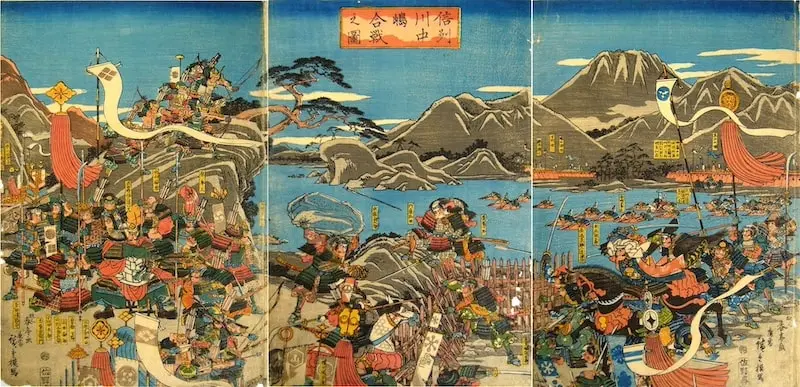
The Sengoku period (1467–1573) was an era of total social and political upheaval characterized by gekokujo—”the low overthrows the high”. Traditional feudal contracts were ignored as ambitious men rose from humble origins to become powerful daimyo through military prowess and betrayal.
| Key Figure | Contribution to Unification |
| Oda Nobunaga | Exploited firearms; seized Kyoto (1568); ended Ashikaga Shogunate |
| Toyotomi Hideyoshi | Disarmed peasantry (Sword Hunt); standardized land surveys; conquered all Japan |
| Tokugawa Ieyasu | Won Battle of Sekigahara (1600); established Edo Shogunate; secured 250 years of peace |
Hideyoshi’s “Sword Hunt” of 1588 was a critical turning point, as it sought to prevent further gekokujo by strictly separating the warrior class from the peasantry, thereby freezing the social structure. Despite the constant warfare, this period saw the arrival of the first Europeans in 1543, who introduced firearms and Christianity. Nobunaga utilized these new technologies to devastating effect at the Battle of Nagashino (1575), demonstrating the shift from individual samurai combat to modern massed infantry tactics.
The Tokugawa Era: Stability through Seclusion
Following the Battle of Sekigahara, Tokugawa Ieyasu established a centralized feudal system based in Edo (modern Tokyo). To ensure stability, the Shogunate implemented the Bakuhan system, which balanced the power of the Bakufu (central government) with the Han (domains) ruled by daimyo.
The Sakoku Policy and Cultural Preservation
Fearing that Christianity and foreign alliances could empower regional lords to challenge the regime, the Shogunate adopted the Sakoku (“closed country”) policy in the 1630s. This policy prohibited Japanese from leaving the country and restricted trade to select Dutch and Chinese merchants at the artificial island of Dejima in Nagasaki.
Modern historians emphasize that Sakoku was not a total isolation but a strategic system of “selective engagement”. It allowed for the development of a unique urban culture—including Kabuki theater, Ukiyo-e woodblock prints, and the haiku poetry of Matsuo Basho—while maintaining a conduit for Western knowledge through Rangaku (Dutch Learning). This era of “secluded peace” led to significant economic growth, high literacy rates, and the development of a sophisticated merchant class in cities like Osaka and Edo.
The Meiji Restoration and the Modern State
The arrival of Commodore Matthew Perry’s “Black Ships” in 1853 exposed the Shogunate’s military and technological obsolescence. The resulting political crisis led to the Meiji Restoration of 1868, which nominally returned sovereign power to the Emperor and initiated a period of rapid Westernization.
Structural Overhaul and Industrialization
The Meiji government abolished the feudal domains, established a centralized prefecture system, and dismantled the samurai class. Under the slogan Fukoku Kyohei (“Enrich the country, strengthen the army”), Japan underwent a comprehensive industrial revolution.
| Reform Pillar | Key Policy Measure |
| Constitutional | Promulgation of the 1889 Meiji Constitution; establishment of the Diet |
| Fiscal | Land Tax Reform (1873) requiring cash payments; stabilized national budget |
| Education | Mandatory universal primary education (1872); 1890 Imperial Rescript on Education |
| Military | National conscription (1873) replacing hereditary samurai warriors |
The state played a proactive role in industrialization, founding “model factories” in textiles, glass, and chemicals before selling them to private entrepreneurs (forming the basis of the zaibatsu conglomerates). By 1912, Japan had successfully revised its “unequal treaties” with Western powers and emerged as a global empire following its victories in the Sino-Japanese and Russo-Japanese Wars.
The Showa Era: From Militarism to the Economic Miracle
The Taisho period (1912–1926) saw a brief flowering of liberal democracy, but the global economic downturn of the 1930s allowed the military to seize control of national policy. Japan embarked on a path of aggressive expansionism in Manchuria and Southeast Asia, leading to its involvement in World War II as an Axis power.
The Allied Occupation and Reconstruction
Following the total defeat of 1945, Japan was occupied by Allied forces under General Douglas MacArthur (SCAP). The occupation implemented fundamental structural reforms:
- Constitutional Reform: The 1947 Constitution redefined the Emperor as a ceremonial “symbol of the state” and renounced the right to wage war (Article 9).
- Land Reform: Dismantled the tenant-farming system to eliminate the rural power base of the old order.
- Zaibatsu Dissolution: Attempted to break up industrial monopolies to democratize the economy, though many re-formed as keiretsu.
The Post-War Economic Miracle (1955–1990)
The Japanese economy recovered to pre-war levels by 1955 and entered a period of unprecedented growth. This was facilitated by the Ministry of International Trade and Industry (MITI), which coordinated national production goals and targeted high-growth sectors like shipbuilding, automobiles, and electronics.
| Economic Driver | Impact on Growth |
| Korean War Orders | Provided critical capital and stimulated heavy industry recovery (1950–53) |
| Income Doubling Plan | Prime Minister Ikeda’s plan to double GDP in 10 years (1960) |
| Quality Control | Adoption of Deming’s statistical theories and Kaizen (continuous improvement) |
| Keiretsu Structure | Interlocking corporate groups provided financial stability and market share |
Japan’s automotive industry, led by Toyota’s Just-in-Time (JIT) manufacturing, and electronics giants like Sony revolutionized global standards for quality and efficiency. By the 1980s, Japan was the production leader in automobiles and a dominant player in the global semiconductor market.
The Plaza Accord, the Bubble, and the Lost Decades
In 1985, the G5 nations signed the Plaza Accord to depreciate the U.S. dollar against the yen and Deutschmark to reduce the U.S. trade deficit. The yen appreciated rapidly, battering Japanese exporters. To mitigate this “yen shock,” the Bank of Japan implemented massive monetary easing.
This excessive liquidity, combined with financial deregulation, fueled a speculative asset price bubble in Japanese real estate and stock markets through the late 1980s. When the Bank of Japan finally raised interest rates to prick the bubble in 1990, the collapse was catastrophic. The subsequent “Lost Decades” (1990s–2010s) were characterized by low growth, deflation, and a credit crunch as banks struggled with non-performing loans.
Contemporary Japan: The Heisei and Reiwa Eras
The Heisei period (1989–2019) was defined by economic stagnation but also by Japan’s emergence as a global cultural superpower through its “Cool Japan” initiative, exporting anime, manga, and video games. The 2011 Great East Japan Earthquake and Tsunami posed a severe test to national infrastructure and the nuclear energy sector.
The Reiwa period began in 2019 with the accession of Emperor Naruhito. Japan today faces critical demographic challenges—a shrinking and aging population that necessitates leadership in robotics, AI, and automation to maintain economic output. Strategically, Japan has shifted its focus from mass-market consumer electronics toward high-value niche technologies, such as advanced sensors and hydrogen fuel cells, maintaining its position as an indispensable link in the global supply chain.
Conclusion
The history of Japan is a testament to the power of institutional continuity and adaptive resilience. From the initial formation of the Yamato state through the Ritsuryo legal codes to the Meiji modernization and the post-war recovery, Japan has consistently utilized state-led initiatives to integrate foreign technology and ideas into its unique social fabric. The “defensive modernization” of the Meiji era and the “quality revolution” of the post-war miracle both demonstrate a collective societal commitment to national excellence and sovereign independence. While the challenges of the Lost Decades and demographic decline are significant, Japan’s long-term historical arc suggests a continued capacity for reinventing its socio-economic model to ensure its relevance in a rapidly evolving global landscape. The transition to the Reiwa era marks a new chapter where Japan’s traditional aesthetics and modern technological prowess must once again find a synergistic balance.