


The historical trajectory of Iran, traditionally conceptualized as the “Guarded Domains” (Mamālek-e Maḥrusah), represents one of the most enduring examples of civilizational continuity in human history. The Iranian plateau has functioned for over five millennia not merely as a geographic expanse but as a distinct political and cultural entity that has repeatedly asserted its identity in the face of external assimilation and internal fragmentation. This continuity is rooted in a sophisticated synthesis of pre-Islamic and Islamic traditions, a resilient administrative heritage, and a unique linguistic evolution that survived multiple conquests by Arabs, Turks, and Mongols. The study of Iran’s history necessitates an understanding of its geopolitical centrality, serving as a conduit for the transmission of ideas, science, and trade across the Silk Roads, while simultaneously developing a highly localized sense of “īrāniyat” or “being Persian”.
- The Elamite Foundation and the Dawn of Urbanization
- The Achaemenid Imperium: The First World Empire
- The Hellenistic Interlude and the Parthian Resurgence
- The Sasanian Revolution: The Second Persian Empire
- The Islamic Encounter and the Golden Age of Persian Science
- The Persianate Literary Tradition: Ferdowsi to Hafez
- The Safavid Unification and the Shia Transformation
- The Qajar Era: Imperialism and the Constitutional Awakening
- The Pahlavi State and the Modernization Crisis
- The Islamic Republic: Internal Factions and Strategic Culture
The Elamite Foundation and the Dawn of Urbanization
The foundations of Iranian civilization were laid long before the arrival of Indo-Iranian speaking tribes. The Elamite period, which began roughly around 2400 BCE, represents the first phase of urban and administrative complexity on the southwestern edge of the plateau. Centered on the dual capitals of Susa in the lowlands and Anshan in the highlands of Fārs, Elam developed a distinctive cultural identity that was both influenced by and a rival to the civilizations of Mesopotamia. The history of Elam is traditionally divided into three distinct phases: the Paleo-Elamite, Meso-Elamite, and Neo-Elamite periods, spanning nearly two thousand years of development.
The city of Susa serves as the primary archaeological witness to this era. Excavations at the “Ville Royale A” site revealed that by 1700 BCE, the Elamite court nobility and high bourgeoisie lived in luxurious homes that provided significant comfort, functioning essentially as small palaces. These urban quarters were surrounded by popular quarters housing artisans and shopkeepers, indicating a highly stratified and specialized society. The economic life of Elam was fueled by long-distance trade; objects discovered in Susa include lapis lazuli from Badakhshan in Afghanistan, chlorite vases from Kerman, and diorite from Oman. This proves that even in the third millennium BCE, the Iranian plateau was a central hub for the exchange of raw materials like stone, wood, and metals.
Elamite Dynastic and Chronological Framework
| Period | Approximate Dates | Key Dynasties and Political Events |
| Paleo-Elamite | ca. 2400–1450 BCE | Awan and Simaški dynasties; interactions with Agadé, Ur III, and Paleo-Babylonian periods. |
| Meso-Elamite | ca. 1450–1100 BCE | Height of Elamite power; expansion onto the plateau; construction of major monuments like Chogha Zanbil. |
| Neo-Elamite | ca. 1100–539 BCE | Retrenchment due to Indo-Iranian migrations; fragmentation into smaller kingdoms; eventual rise of the Achaemenids. |
The Paleo-Elamite period was characterized by frequent conflicts with the Mesopotamian empires of Akkad and Ur. The kings of Awan, such as Luhhiššan and Hišephatep, famously fought against Sargon of Akkad and his son Rimuš. However, the last king of the Awan dynasty, Puzur-Inšušinak, managed to subdue Susa and unite the Elamite lands, even launching attacks into northern Mesopotamia. By 2004 BCE, Elam was strong enough to bring an end to the Empire of Ur, subsequently annexing Susiana and founding the Epartid (sukkalmah) dynasty. This era established a federal model of governance, where kings of provinces or vassal states operated under a “king of kings,” a structural hierarchy that would become a hallmark of later Persian empires.
The transition from Elamite to Persian dominance was not a sudden erasure but a gradual synthesis. In the first millennium BCE, the spread of populations speaking Indo-Iranian languages forced the Elamites to relinquish territory and seek refuge in Susiana. Yet, the Achaemenids who succeeded them did not discard the Elamite legacy; instead, they adopted Elamite administrative techniques, utilized the Elamite language for royal records, and maintained Susa as one of their primary administrative capitals. The Elamite influence on Achaemenid culture was profound, providing the fledgling Persian state with a ready-made model for bureaucratic and urban organization.
The Achaemenid Imperium: The First World Empire
The rise of the Achaemenid dynasty (ca. 700 to 330 BCE) represents the zenith of ancient Iranian political achievement. Under the leadership of Cyrus the Great, the Persians unified the various tribes of the plateau and overthrew the Median Empire in 550 BCE. Cyrus’s genius lay in his ability to create a multinational empire that embraced all previous civilized states of the ancient Near East, including Lydia and Babylon. This was the first true world empire, characterized by a unique model of centralized rule that respected the diverse customs, religions, and laws of its subjects.
Darius I, “the Great,” further institutionalized this imperial vision. His reign saw the empire reach its maximum extent, stretching from the Scythians beyond Sogdiana to Nubia, and from the Indus Valley to the Greek cities of Lydia. Darius’s most significant achievement was the creation of a tightly organized, centralized administration. The empire was divided into satrapies (administrative districts), each overseen by a satrap appointed by the king. To prevent rebellion, the central government maintained a system of royal inspectors and a sophisticated communication network facilitated by the Royal Road.
Achaemenid Imperial Administration and Ideology
| Administrative Feature | Description and Significance |
| Satrapy System | Division of the empire into provinces with clearly defined boundaries and taxation requirements. |
| Divine Right | Kings ruled as representatives of Ahura Mazdā, emphasizing truth (Arta) against the lie (Drauga). |
| Cultural Tolerance | Restoration of local cults (e.g., Marduk in Babylon) and protection of religious minorities (e.g., Jews in Jerusalem). |
| Communication | The Royal Road and postal systems connected distant corners of the empire, ensuring rapid response to threats. |
| Artistic Eclecticism | Integration of Greek, Egyptian, and Mesopotamian artistic elements into a unique imperial Persian style. |
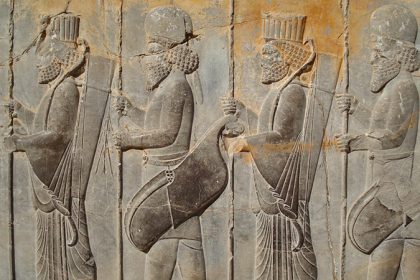
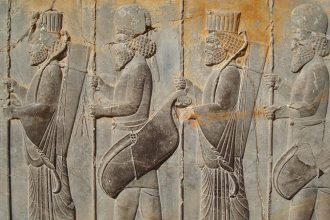
The Achaemenid court at Susa and Persepolis reached a high level of cultural and artistic sophistication. Persepolis, initiated by Darius I, served as the ritual and representative center of the empire, featuring monumental buildings like the Apādāna (Audience Hall) and the “Hall of a Hundred Columns”. Achaemenid art was fundamentally a solemn, imperial art designed to glorify the dynasty and symbolize world dominion. This era also produced the Bisotun inscription, a trilingual royal record in Old Persian, Elamite, and Babylonian, which provided the essential historical and genealogical data that allowed modern scholars to reconstruct Achaemenid history.
Despite its vast power, the Achaemenid Empire faced persistent challenges from the Greek cities of the West and internal rebellions by ambitious satraps. The unsuccessful invasions of the Greek mainland in 492, 490, and 480 BCE marked the limits of Persian expansion. Eventually, the empire’s structural complexity became a liability; under Darius III, it was described as a “colossus on feet of clay,” unable to withstand the rapid military advances of Alexander the Great. Alexander’s conquest in 330 BCE brought an end to the first Persian empire, yet the Achaemenid model of centralized rule over diverse peoples remained a standard for all subsequent empires in the region.
The Hellenistic Interlude and the Parthian Resurgence
The death of Alexander in 323 BCE led to the fragmentation of his conquests among his generals, the Diadochi. Seleucus I Nicator established the Seleucid Empire, which controlled much of Iran, Mesopotamia, and Syria for two centuries. The Seleucids viewed themselves as the heirs to the Achaemenids and initially governed from ancient centers of power like Susa and Babylon. This period saw the development of Hellenistic art—a fusion of Greek and Near Eastern traditions—and the founding of Greek-style cities such as Seleucia-on-the-Tigris. However, the Seleucid grip on the eastern provinces was tenuous, challenged by local satraps and nomadic incursions.
The resurgence of Iranian political power originated in the northeast with the rise of the Parni, a nomadic group that settled in the satrapy of Parthia around 246 BCE. Led by Arsaces I, the founder of the Arsacid (Parthian) Empire, this group successfully defeated the Seleucid satrap Andragoras and began a slow expansion across the plateau. By the reign of Mithridates I (r. 171–132 BCE), the Parthians had seized Media and Mesopotamia, establishing a major cultural and political power that would endure for nearly five centuries.
The Parthian Empire: A Duality of Identity
| Historical Dimension | Characteristics of the Arsacid State |
| Governance | A loosely organized monarchy that integrated Iranian and Hellenistic administrative patterns. |
| Culture | Adoption of Greek, Persian, and regional cultures; use of multilingual administration (Aramaic, Greek, Parthian). |
| Military | Famous for horse archers and heavy cavalry (Cataphracts); successful defense against Roman incursions. |
| Economy | Control of the Silk Road trade routes; promotion of commerce between the Far East and Rome. |
| Diplomacy | Rivals of the Roman Republic and Empire; constant struggle over the Kingdom of Armenia. |
The Parthian Empire was characterized by a decentralized, almost feudal structure. Unlike the Achaemenids, the Arsacids relied on a military aristocracy consisting of “Great Houses” such as the Sūrēn and the Kāren, who held significant power in their respective domains. Their task was primarily to establish effective government and secure frontiers against the Romans in the west and Scythian nomads in the north. This era was one of relative religious tolerance; while Zoroastrianism remained influential, the Parthians also provided protection for Jewish populations in Babylonia and Adiabene and presented themselves as “Philhellenes” (friends of the Greeks) to appease the urban Greek populations within their empire.
The rivalry with Rome became the defining feature of Parthian foreign policy. The borders of Mesopotamia were a frequent battleground, with the Parthians notably destroying the army of Marcus Licinius Crassus at the Battle of Carrhae in 53 BCE. Despite these successes, the empire was frequently destabilized by civil wars between contenders for the throne and the lack of a strong centralized bureaucracy. By the early third century CE, the combination of chronic civil strife, devastating epidemics, and repeated wars with Rome (who sacked Ctesiphon in 165 and 198 CE) left the Arsacid house vulnerable to internal revolt.
The Sasanian Revolution: The Second Persian Empire
The overthrow of the Arsacids in 224 CE by Ardashir I, the ruler of Persis, marked the birth of the Sasanian Empire—often called the “Second Persian Empire”. Ardashir and his successor Shapur I sought to revive the glory of the Achaemenids, seeking to reunite the Iranian peoples under a much more centralized and ideologically rigid state. They officially designated their realm as Ērānšahr (Empire of the Iranians), a term that codified the link between the territory and the Iranian national identity. This period saw the formalization of Zoroastrianism as a cornerstone of state ideology, though its status as an official state religion was a gradual process.
The Sasanian administration was characterized by a powerful bureaucracy and a centralized revenue system. Ardashir I replaced vassal kings with his own family members and strengthened the military by adopting Roman-style chain armor and advanced siege technology. Society was organized into a rigid class structure: the warriors (artēshtarān), the commoners or cultivators (wāstaryōshān), and the clergy (asrōnān). This hierarchy was symbolized by three great sacred fires—Ādur Gošnasp, Ādur Buzēn Mehr, and Ādur Farnbāg—each associated with one of the classes.
Sasanian Social and Administrative Hierarchy
| Rank/Category | Key Roles and Characteristics |
| King of Kings | The absolute monarch, ruling by divine grace; kindling of a “royal fire” upon accession. |
| The Seven Great Houses | Powerful noble families (e.g., Mihrān, Spāhbed) who held high civil and military positions. |
| The Bureaucracy | Highly trained scribes (dībirān) who managed tax collection, land surveys, and diplomatic records. |
| The Priesthood | A graded hierarchy of mowbeds, with the mowbedān mowbed at the head of the clerical class. |
| The Military | A professional standing army centered on the Savārān (heavy cavalry) and supported by state arsenals. |
The Sasanians were also great city-builders and engineers. Ardashir I founded at least eight cities, and Shapur I was renowned for the construction of massive infrastructure projects, including dams, bridges, and forts, often utilizing skilled labor from Roman prisoners of war. The Sasanian economy was fueled by intensive agriculture, requiring sophisticated irrigation systems like qanats (underground canals) and bridge dams to manage water resources. International trade was also strictly controlled by the crown; Sasanian silver coins were used as currency as far away as Chinese Turkestan and the Baltic Sea, reflecting the empire’s status as an economic powerhouse.
Culturally, the Sasanian period acted as a “great shield” protecting Western Asian culture against nomadic incursions from Central Asia. The court patronized the translation of Greek and Indian scientific and philosophical works into Middle Persian, a legacy that would later prove vital for the Islamic Golden Age. Sasanian manuals on statecraft, such as the political testament of Ardashir I, remained respected guides for governance well into the Islamic period. However, after four centuries of peer competition with the Byzantine Empire, the Sasanian state was exhausted by the long wars of Khosrow II, leaving it unable to resist the sudden and energetic expansion of the Arab Islamic armies in the mid-seventh century.
The Islamic Encounter and the Golden Age of Persian Science
The Arab conquest of the Sasanian Empire (ca. 651 CE) introduced a new religious and social order, yet it did not result in the disappearance of the Iranian identity. While Zoroastrianism declined, the Iranian people preserved their language and used the transition to the Abbasid Caliphate (750 CE) to regain their influence. Under the Abbasids, Iranians became the scribes, bureaucrats, and writers of the Islamic world. The caliphate’s capital, Baghdad, founded in 763, became a meeting place for Persian, Greek, and Indian intellectual traditions, leading to the “Islamic Golden Age”.
The Persian contribution to this cultural flourishing was foundational. The Barmakid family, who served as advisors to the caliphs from 750 to 803, were instrumental in fostering the translation movement, bringing Pahlavi historical and scientific works into Arabic. They also established the first paper mill in Baghdad, which democratized information by making books affordable for the first time in history. Persian polymaths such as Al-Khwarizmi, Al-Razi, and Ibn Sina (Avicenna) made revolutionary contributions to mathematics, medicine, and philosophy.
Key Scientific and Philosophical Contributions of Persian Scholars
| Scholar | Field of Study | Major Work or Innovation |
| Al-Khwarizmi | Mathematics | Creation of the discipline of Algebra (Kitāb al-Jabr); introduction of Indian numerals. |
| Al-Razi (Rhazes) | Medicine | Polymathic synthesis of Greek and Persian medical knowledge; author of works on smallpox and measles. |
| Ibn Sina (Avicenna) | Medicine/Philosophy | The Canon of Medicine, which served as a European medical textbook for centuries. |
| Al-Biruni | Astronomy/History | Calculation of the Earth’s radius; detailed ethnographical studies of India. |
| Al-Farabi | Philosophy | Reconciliation of Greek rationalism (Plato/Aristotle) with Islamic theology. |
The Golden Age was defined by the synthesis of ancient sciences and Islamic revelation. Scholars at the House of Wisdom in Baghdad translated the surviving philosophical and scientific traditions of the ancient world into Arabic, often using Persian as an intermediary language. The practice of ijtihad (independent reasoning) allowed for a dynamic exploration of universal themes such as the nature of divine love, morality, and the human condition. This period also saw the development of sophisticated engineering skills, as evidenced by the expansion of the qanat irrigation systems that transformed arid landscapes into productive agricultural zones.
The preservation of the Persian language was central to this cultural resilience. Unlike Egypt or Syria, which adopted Arabic as their primary tongue, Iran maintained its linguistic identity, albeit with a new script and many Arabic loanwords. The emergence of “New Persian” in the ninth and tenth centuries, particularly under regional dynasties like the Samanids in Khorasan, provided a vehicle for the articulation of complex cultural narratives. This linguistic continuity allowed Iranians to preserve a collective memory of their pre-Islamic past, which they integrated into their new Islamic identity.
The Persianate Literary Tradition: Ferdowsi to Hafez
As the political unity of the caliphate fractured, the Iranian plateau saw the rise of local dynasties and the emergence of a distinctive Persianate literary culture. The most significant figure in this movement was Ferdowsi, whose epic poem, the Shahnameh (Book of Kings), completed in the early 11th century, codified the mythology and history of Iran from its creation to the fall of the Sasanians. The Shahnameh provided a national narrative that resonated with the cultural identity of the Persian-speaking world, ensuring that the pre-Islamic heritage would not be forgotten under the weight of Islamic hegemony.
The subsequent centuries, despite the trauma of the Mongol and Timurid invasions, were the “Golden Age” of Persian poetry. The mystical philosophy of Sufism deeply influenced literary expression, enriching it with themes of unity with the divine and spiritual enlightenment. Poets like Rumi, born in Central Asia and living in Anatolia, wrote in Persian and offered deep insights into the nature of divine love and existential truth. Hafez, the 14th-century lyric poet of Shiraz, became a genius of the ghazal form, using intricate metaphors to explore intricate social issues and human emotions.
Pillars of the Classical Persian Literary Tradition
| Poet | Primary Form/Theme | Cultural Impact and Legacy |
| Ferdowsi | Heroic Epic (Shahnameh) | Revived the Persian language; established the national narrative of Iran. |
| Rumi | Mystical Verse (Masnavi) | Transcended literary boundaries; central figure in Sufi philosophy and world spirituality. |
| Hafez | Lyrical Ode (Ghazal) | Master of metaphor; his work remains a primary vehicle for socio-political expression. |
| Saadi | Moral Prose/Poetry (Bustān) | Explored universal human emotions and ethical reflections on governance. |
| Omar Khayyam | Quatrains (Rubaiyat) | Synthesized scientific inquiry with philosophical musings on the ephemeral nature of life. |
The enduring influence of Persian literature is evidenced by its impact on literary cultures worldwide, with figures like Goethe recognizing it as one of the four main bodies of world literature. In the 19th century, this tradition began to evolve into a vehicle for socio-political protest, as reformers like Amir Kabir and poets like Ali-Akbar Dehkhoda challenged traditional forms to reflect the realities of a country in transition. Poetry remains a major factor in preserving a sense of collective awareness among Iranians, functioning as a bridge between the legendary pre-Islamic past and the complexities of the modern present.
The Safavid Unification and the Shia Transformation
The emergence of the Safavid dynasty in 1501 marked the beginning of modern Persian history and the genesis of the Iranian nation-state. Under Shah Ismail I, the Safavids unified much of the plateau under a single political control for the first time since the Arab conquests. Most significantly, Ismail proclaimed Twelver Shi’ism as the official state religion, creating a distinct ideological boundary that separated Iran from its Sunni neighbors, particularly the Ottoman Empire. This decision initiated the most momentous religious change in Iranian history and fostered a unified national consciousness among the country’s diverse ethnic elements.
The Safavids introduced a concept of patrimonial kingship that combined territorial authority with religious legitimacy. The dynasty drew inspiration from the Turco-Mongol tradition of Timur as well as the mythological kings of the Shahnameh. Shah Abbas I, the greatest of the Safavid rulers, further centralized the state by reducing the power of the Qizilbash—the Turkmen tribal groups that served as the military elite—and establishing a standing army of ghulams (slave-soldiers) and musketeers trained in early modern warfare.
Safavid State Organization and Administrative Reforms
| Category | Policy and Institution | Historical Result |
| Religious | Proclamation of Twelver Shi’ism | Established a hybrid Iranian-Shi’ite national identity. |
| Military | Creation of the Ghulām units | Reduced dependency on nomadic tribal levies; professionalized the army. |
| Economic | Promotion of Global Trade | Revived Iran as an economic stronghold between East and West. |
| Urban | Movement of Capital to Isfahan | Created a masterpiece of architectural innovation and patronage. |
| Diplomatic | Ties with European Powers | Introduced Iran to Western technological and political developments. |
Under the Safavids, Persian replaced Arabic as the primary vehicle for theological discourse, further cementing the national identity. The state transitioned from a tribal nomadic order into a sedentary society funded by agriculture and trade. Isfahan, the capital under Shah Abbas, became the center of Safavid architectural achievement, featuring iconic monuments like the Masjed-e Shāh and the Meydān-i Shāh. Despite their military successes against the Ottomans and Uzbeks, the dynasty eventually entered a period of decline after the death of Abbas I, finally collapsing after the Afghan capture of Isfahan in 1722.
The 18th century was a period of fragmentation and civil war, briefly interrupted by the reign of Nadir Shah Afshar (r. 1736–1747). Nadir Shah reunited the Iranian realm, removed Ottoman and Russian invaders, and launched a massive campaign into India, bringing back the Peacock Throne and enormous wealth. However, his rule was marked by extreme cruelty and heavy taxation, leading to his assassination and the subsequent disintegration of his empire. The Zand dynasty, led by Karim Khan Zand (r. 1750–1779) in Shiraz, provided a rare interlude of tranquility and artistic revival, where Karim Khan ruled as “Regent of the Subjects” (Wakil al-ra’aya) rather than assuming the title of Shah.
The Qajar Era: Imperialism and the Constitutional Awakening
The Qajar dynasty (1796–1925) assumed power in a country weakened by decades of civil strife and facing the new challenge of European imperialism. Throughout the 19th century, Iran was the victim of the “Great Game”—the diplomatic and military rivalry between Russia and Britain. The Qajars suffered massive territorial losses in the Caucasus following the Russo-Persian Wars (1804–1813 and 1826–1828); the treaties of Gulistan and Turkmenchay ceded Azerbaijan, Georgia, and Armenia to the Russian Empire. Furthermore, British intervention in the mid-19th century forced the Qajars to renounce all claims to Herat in modern-day Afghanistan.
Economically, the country became a semicolonized source of cheap raw materials like opium, rice, and tobacco for Western markets, while being flooded with industrial goods. To finance their lavish lifestyles and trips to Europe, Qajar leaders granted foreign companies exclusive concessions over Iranian resources. This policy sparked intense domestic opposition, most notably in the 1890 Tobacco Protest, where a religious decree led to a nationwide boycott of tobacco, successfully forcing the Shah to cancel a British monopoly. This event signaled the political awakening of the clergy, merchants, and a nascent intellectual class.
Significant Territorial Losses and Treaties (19th Century)
| Treaty | Year | Foreign Power | Territories Lost or Impact |
| Gulistan | 1813 | Russia | Cession of Azerbaijan, Dagestan, and eastern Georgia. |
| Turkmenchay | 1828 | Russia | Cession of Erivan and Nakhchivan; granted Russian commercial agents access. |
| Paris | 1857 | Britain | Iranian renunciation of all claims to Herat and western Afghanistan. |
| Akhal | 1881 | Russia | Formalized Russian control over Turkmenistan and Uzbekistan (Merv). |
| Anglo-Russian Convention | 1907 | UK & Russia | Divided Iran into exclusive spheres of influence for Britain and Russia. |
The systemic failures of the Qajar regime culminated in the Constitutional Revolution of 1905–1911. A diverse coalition of ulama, merchants, and intellectuals demanded the establishment of a formal rule of law and an elected parliament (Majles) to curb royal power. While the revolution initially succeeded in creating a constitution in 1906, its reforms were often stifled by foreign intervention and internal strife. The disruption caused by World War I, with the Ottoman, British, and Russian empires occupying parts of Iran, further undermined the dynasty, setting the stage for the rise of a military officer named Reza Khan.
The Pahlavi State and the Modernization Crisis
In 1921, Reza Khan, commander of the Persian Cossack Brigade, seized power in a coup, eventually establishing the Pahlavi dynasty in 1925. Determined to modernize and centralize Iran, he utilized a Western model of industrial development and implemented a secularizing agenda that aimed to diminish religious authority. He established a system of political dictatorship while simultaneously building infrastructure, such as railways and hospitals. However, his perceived pro-German sympathies during World War II led to his forced abdication by Allied forces in 1941, with the crown passing to his son, Mohammad Reza Pahlavi.
The post-war period was defined by a democratic struggle led by Prime Minister Mohammad Mosaddegh, who sought to nationalize the British-controlled oil industry. The resulting Abadan Crisis and Mosaddegh’s challenge to Western interests led the CIA and MI6 to orchestrate a coup d’état in 1953 (Operation Ajax) to restore the Shah to power. The success of this operation consolidated the Shah’s rule as a pro-Western absolute monarch but sowed the seeds of deep-seated resentment toward foreign interference.
Socio-Economic Factors Leading to the 1979 Revolution
| Factor | Mechanism of Impact | Consequence for the Regime |
| The White Revolution | Aggressive modernization/land reform that upended traditional rural economies. | Rapid urbanization and the creation of a disenfranchised urban “working poor.” |
| Political Repression | Marginalization of opposition parties; widespread use of surveillance and torture (SAVAK). | United secular leftists and religious conservatives against the Shah. |
| Westernization | Rapid shift in social norms that alarmed the conservative clergy and religious classes. | Perception of the Shah as a “puppet” of Western culture and imperial interests. |
| Economic Instability | High inflation following the 1973 oil boom; uneven distribution of wealth. | Broad-based discontent among the “bazaari” merchants and unemployed youth. |
| Foreign Dependence | Heavy reliance on U.S. military aid and close ties with Israel. | Fueled nationalist and Islamist rhetoric regarding the loss of sovereignty. |
In the 1960s and 70s, the Shah launched the “White Revolution,” which included land reforms and women’s suffrage but also led to rapid urbanization and a “cultural vacuum” for rural migrants who felt alienated by modern urban Iran. Opposition to the Shah’s autocracy grew as SAVAK, the secret police, cracked down on dissent. Ayatollah Ruhollah Khomeini, exiled in 1964 for criticizing the regime’s irreligion and subservience to foreign powers, became a populist figurehead, his messages smuggled into the country on cassette tapes. By 1978, mass protests and strikes disrupted the economy, eventually forcing the Shah and his family to flee the country in January 1979.
The Islamic Republic: Internal Factions and Strategic Culture
The 1979 Revolution replaced the pro-Western monarchy with an Islamic Republic based on the concept of Velayat-e Faqih (Guardianship of the Jurist), which grants the clergy supreme authority over governance. This shift radically altered Iran’s international standing, as the new regime pursued an anti-Western, “revolutionary” foreign policy. The early years of the republic were defined by the U.S. Embassy hostage crisis and the brutal eight-year Iran-Iraq War (1980–1988), which the regime used to consolidate domestic power and foster a “collective siege mentality”.
Since the death of Khomeini in 1989, the Islamic Republic has been defined by an internal struggle between hardline conservatives (osulgarayan) and reformists (eslahtalaban). This clash addresses fundamental questions about the nature of Iranian society: whether people possess inalienable rights or divine duties, and whether Islam is compatible with democracy. The reformist movement, which peaked under President Mohammad Khatami (1997–2005), advocates for individual freedoms and engagement with the West, while hardliners, often supported by the Islamic Revolutionary Guard Corps (IRGC), adhere strictly to the revolutionary values of the 1979 era.
Comparison of Modern Iranian Political Factions
| Feature | Hardliners (Osulgarayan) | Reformists (Eslahtalaban) |
| Core View | Priority on “Islamic values” and the authority of the Supreme Leader. | Emphasis on “civil society,” individual rights, and democratic interpretation. |
| View of the West | Conspiratorial lens; see the West as an existential enemy of Islam. | Believe engagement with the West can strengthen the state and economy. |
| Key Ideology | Strict adherence to the views of Ayatollah Khomeini. | Modernist reading of Islam that adapts to societal conditions. |
| Security Policy | Support for “Strategic Depth” and regional intervention (e.g., Syria). | Prefer smart statecraft and global diplomacy over military expansion. |
| Domestic Stance | Justify repression to maintain national unity and Shia solidarity. | Seek press freedoms, political participation, and legal reforms. |
Iran’s strategic culture is characterized by a dichotomy between a belief in perpetual victimization—stemming from historical invasions and imperial humiliation—and an optimism in inevitable resurgence. The regime utilizes Shi’ite mythology, particularly the principle of confronting injustice (mazloumiat), to justify its assertive regional policies and project power across borders. Rituals like Ashura commemorations and martyrdom ceremonies function as collective experiences that reinforce group solidarity and regime legitimacy.
Despite the internal political rifts and external sanctions, the Iranian national identity remains resilient. Iranians have consistently used their language and culture to maintain a distinct entity, even when under foreign rule. The hope for future redemption and the historical consciousness of a shared tie to Irān-zamin (the land of Iran) continue to serve as a unifying force. The modern Iranian state, therefore, is a complex hybrid of ancient political heritage, Persian literature, and religious identity, constantly negotiating its role between tradition and the demands of the modern world.
The history of Iran is a narrative of persistence. From the sophisticated urbanization of Elam to the administrative genius of the Achaemenids, and from the scientific advancements of the Golden Age to the revolutionary transformation of the Safavids and the modern Islamic Republic, the Iranian plateau has remained a vital center of human civilization. The “Guarded Domains” continue to evolve, their identity forged in the interplay between geographic centrality, imperial ambition, and a profound cultural memory that has survived for over five thousand years.